Hip Extension for Athlete Performance
May 25, 2026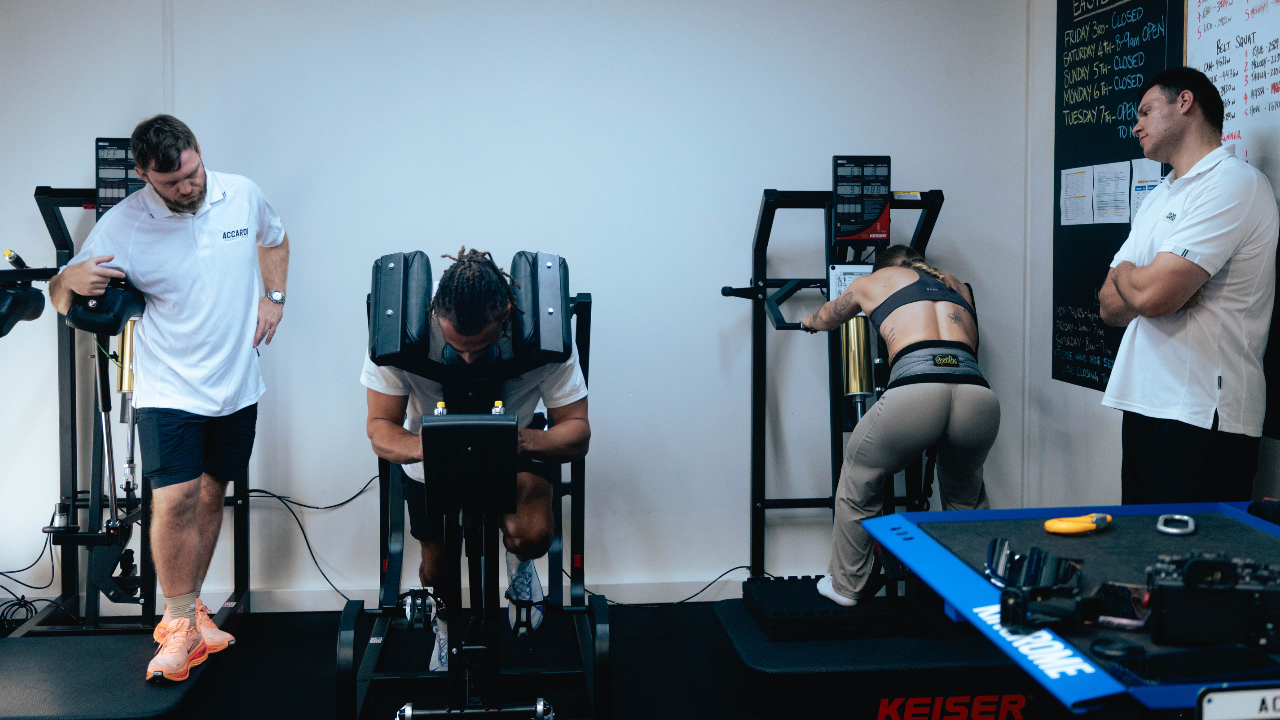
Hip extension is one of the most important pieces of the athletic development puzzle. Its function is responsible for creating hip torque, a rotational force, which coordinates movements like running, jumping, throwing and lifting. The development of hip extension has been a priority in our programs, helping to build more powerful athletes from our bobsledder Lachie McPherson to national champions in weightlifting, Zoe Pukekura and Luke Fulham! As this has been a major theme in our gym, this guide aims to provide insight into what to look for and the methods we use. This guide is essential for coaches as athletes often come into the gym with the same presentation of limited hip rotation, coordination, and a lack of glute development! It’s time to make it a priority!
Muscle Architecture
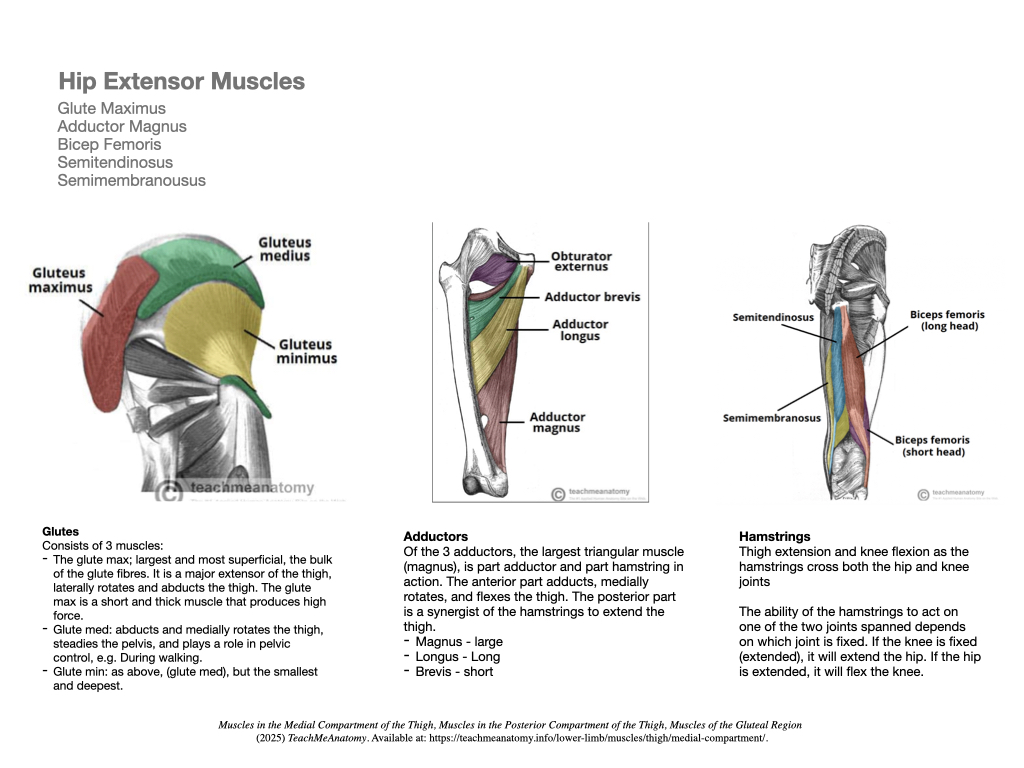
Hip extension is the production of force through hip rotators, the glutes, hamstrings and adductor muscles. These muscles are the hip extensor group, as they produce the greatest torque across the hip compared to other hip muscles (Marieb et al., 2014). With three prime movers, there are increased movement options, allowing the body to be flexible and assist with coordination. Several factors will influence the coordination of the hip extensors. For example, a lack of glute max development may cause athletes to rely heavily on the use of adductor magnus and the hamstrings. While these strategies may be the best option for the athlete right now, they may not always be the best for long-term performance. With our athletes, we focus on balancing the contributions of these muscles, rather than relying on one group, as this often causes issues with mechanics and may limit training intensity.
What does it look like?
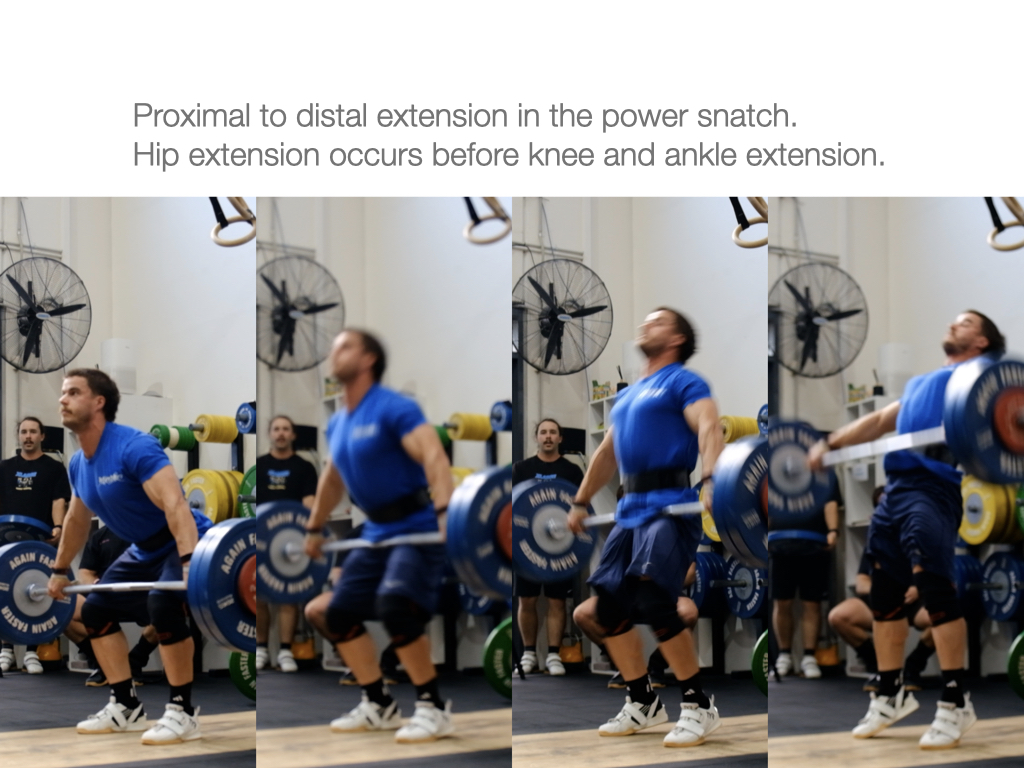
Hip extension can be seen in sporting movements as the proximal-to-distal extension of the body’s joints. This means during force production, joints closest to the body will extend first, for example, the hip during the second pull of a snatch (see graphic below), and then move to the distal joints like the knee and the foot.
Why is it so vital to performance?
Increased hip torque has far-reaching effects on the athlete’s movement strategy and power output. These changes can influence coordination and efficiency of movement, change of direction and speed by providing the range of motion and force needed.
Movement Efficiency
Improving the function of the hip allows for the forces to be better dispersed throughout the rest of the body. Hips that can function allow muscles to perform their specialised roles and improve movement. For example, muscles like the rectus femoris are biarticular and are often seen as energy transporters in the force-producing equation (Bosch, 2015). With our weightlifters specifically, the improvement in range of motion and muscle tissue at the hip has allowed our athletes to become more robust, having fewer soft tissue “niggles”.
Peak Power
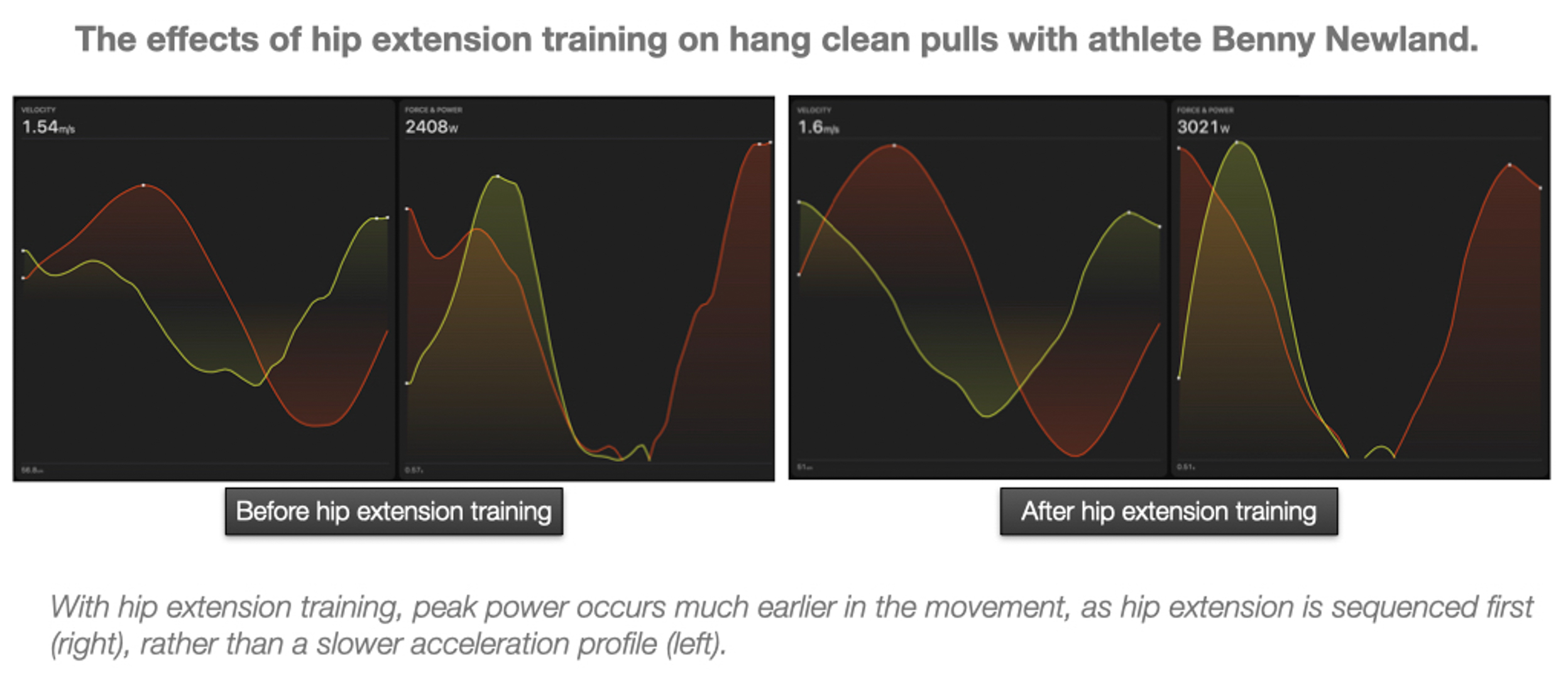
In almost all sports, time is limited when performing athletic movements. Developing the hip extensors can improve acceleration by improving the power production in the earlier phases of the movement, essentail for sport. With athlete Benny Newland, hip extension training has been a priority, working to improve range of motion and power in the hips. We've used a variety of exercises to do this (see video below for exercises and clean pull progression), showing major changes to the way he executes his weightlifting. In the graphic below, we can see that power is produced much earlier, with the acceleration profile of the movement being much more aggressive.
Benny Newland Clean Pull and Hip Extension Progression
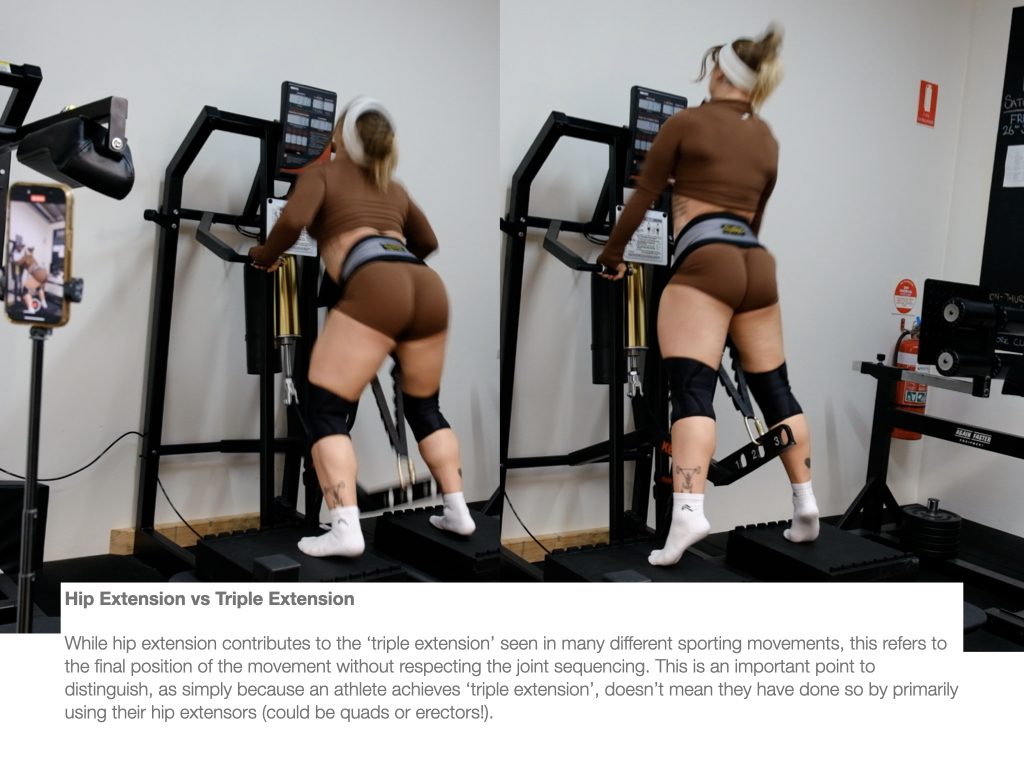
Such changes can also be made to athletes when performing jumping and throwing. In sprinting, for example, powerful hip extensors can improve acceleration mechanics and help to minimise braking forces. This allows the athlete to continue to build velocity with each step. If the athlete struggles with hip extension, they may increase the reliance on other strategies, such as knee extension from the quads, which may influence the coordination and sequencing of the rest of the steps, limiting their performance.
Training Hip Extension
The gym can be one of the most impactful environments for a developing athlete. Addressing an athlete’s hip extension demands in the gym is no different, and despite the implications for performance, it is often significantly underdeveloped. By making it a priority in the program, we can drastically change the way our athletes perform their sport. The athlete’s program should help to unlock more hip extension by addressing:
- The musculoskeletal system.
- Improving the range of motion and coordination.
- Rate of force development.
We’ll take you inside our facility and show you how we focus on making hip extension a priority in the program. In this section of the hip extension guide, we’ll detail some of the methods we use with our athletes to build power that starts from the hip!
‘Hip Prep’
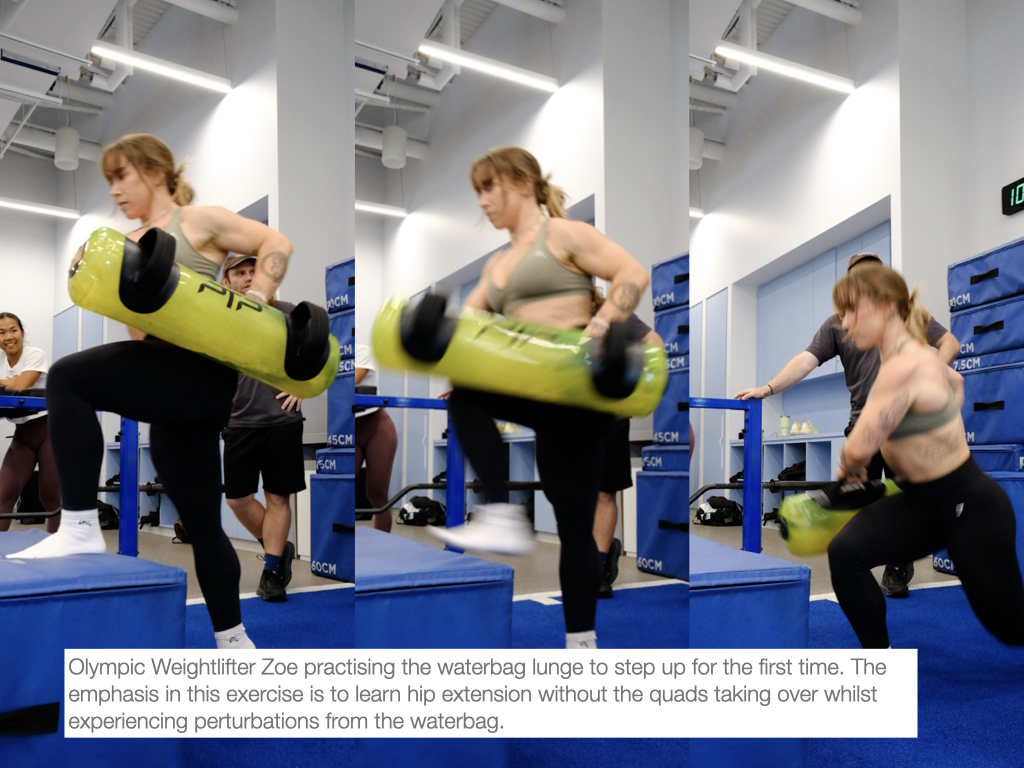
Addressing the athlete’s hip range of motion and function through a variety of planes is the first step in improving hip extension. These exercises won’t directly increase strength or power, but their value is in improving body awareness (see graphic below of Zoe performing waterbag step up) and reducing large deficits in range of motion, which may reduce inhibition to load the hip muscles. We use a variety of hip exercises with our athletes, often to lengthen the glute muscles and provide a loaded stretch. When performing the exercises below, it’s important to ensure that the range of motion comes from the hip, minimising compensation from areas like the spine (athletes will do everything to bastardise the movement, especially if they cannot create hip extension!). Below are examples of exercises we use with our athletes. I recommend 2-3 exercises before a lower-body session, rotating movements frequently. Example exercises are provided below:
Single Leg RDL
Waterbag Lunge to Step Up
Hip Hike
Reverse Leg Press
When I initially purchased a Smith machine and a cage in late 2024, I expected to be primarily using it for band-resisted squatting, bench press and jumps. Today, it’s permanently draped in Spud Inc. Pittsburgh jammer arms, set up for an exercise I learned from Dr. Chris Dale, the reverse leg press. In our system, the reverse leg press is classed as a ‘coordinative strength’ exercise, teaching the athlete how to push with the glutes, while also stabilising the pelvis on the stance leg (the standing leg). While extremely loadable, at first, this movement may be difficult to coordinate as the athlete struggles to push with the hip extensors, often favouring the quads or spinal erectors. There will often be a ‘tug-of-war’ between these muscle groups until the athlete can successfully coordinate this action. Additionally, this exercise will expose athletes who struggle with balancing the pelvis, often feeling it in the non-working leg as the glute works to keep the pelvis in the correct position.
Be patient and coach the movement slowly with a light weight. Your athlete should feel their glutes working. Focus on pushing the heel back and down, rather than heel up, to avoid excessive lumbar extension or knee extension. In addition to building glute mass, the reverse leg press also works to develop the cooperation between muscles, as peak power may sometimes be limited by poorer intermuscular coordination (Bosch, 2015). Typically, this exercise is programmed as either ‘movement prep’ to begin a session at a lighter load or following strength and power exercises as an accessory.
National Weightlifter, Tiffany Wang Hip Extension Progression (Hang Cleans)
Reverse Leg Press Exercise Set Up
Box Step Ups
In many athletic movements, there is a short acceleration period of the body or object. The box step-up allows us to train within these constraints by providing a short timeframe to produce force. As the exercise is concentric only, the athlete must create tension and overcome muscle slack fast, not relying on a countermovement from an eccentric contraction. This can assist in overcoming muscle slack, helping to reduce the time it takes to build up tension, often more important than the total power it can produce (Bosch, 2015). As a result, there may be an increase in the muscle’s operative tension, reducing the time it takes for the muscle to be taught, ultimately allowing for faster speed of contraction.
When coaching the step-up for hip extension, it's important to ensure the movement starts from the hip, not from knee extension. Coaching the athlete to slice the box by pulling from the heel as they stand on the box will increase the contribution of the hip extensors and help sequence the movement. The athlete should feel their glutes working harder here as a powerful hip extension will send the athlete forward, as the non-working leg floats up onto the box, almost reflexively.
Box Step Up Exercise Set Up
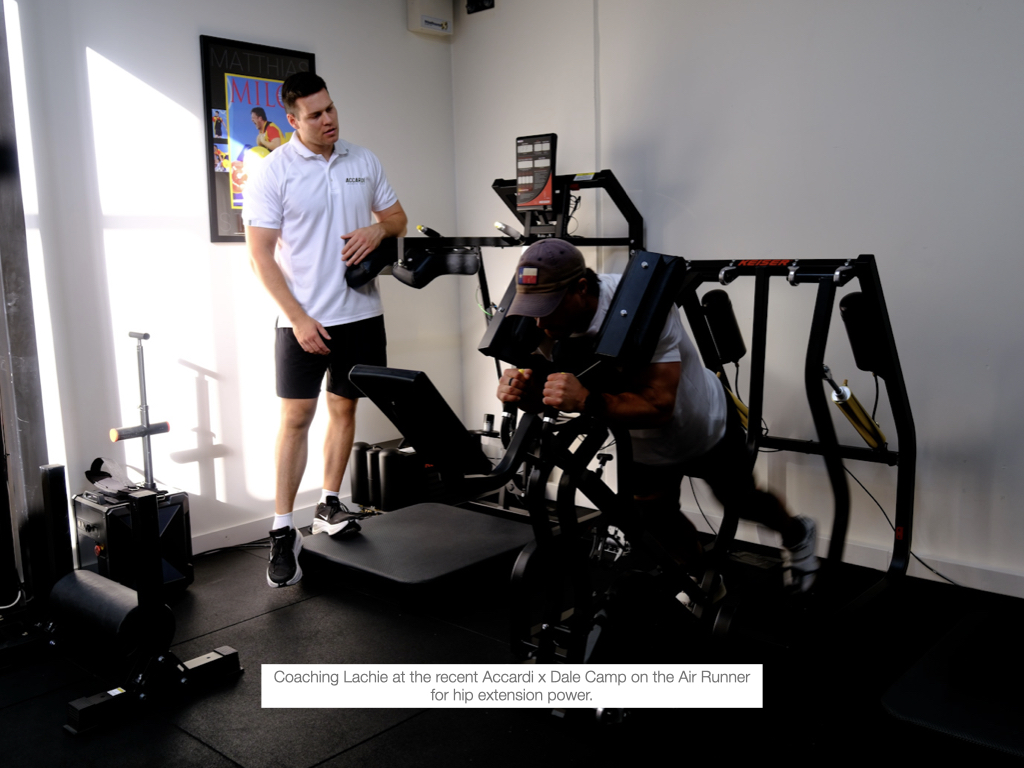
Air Runner
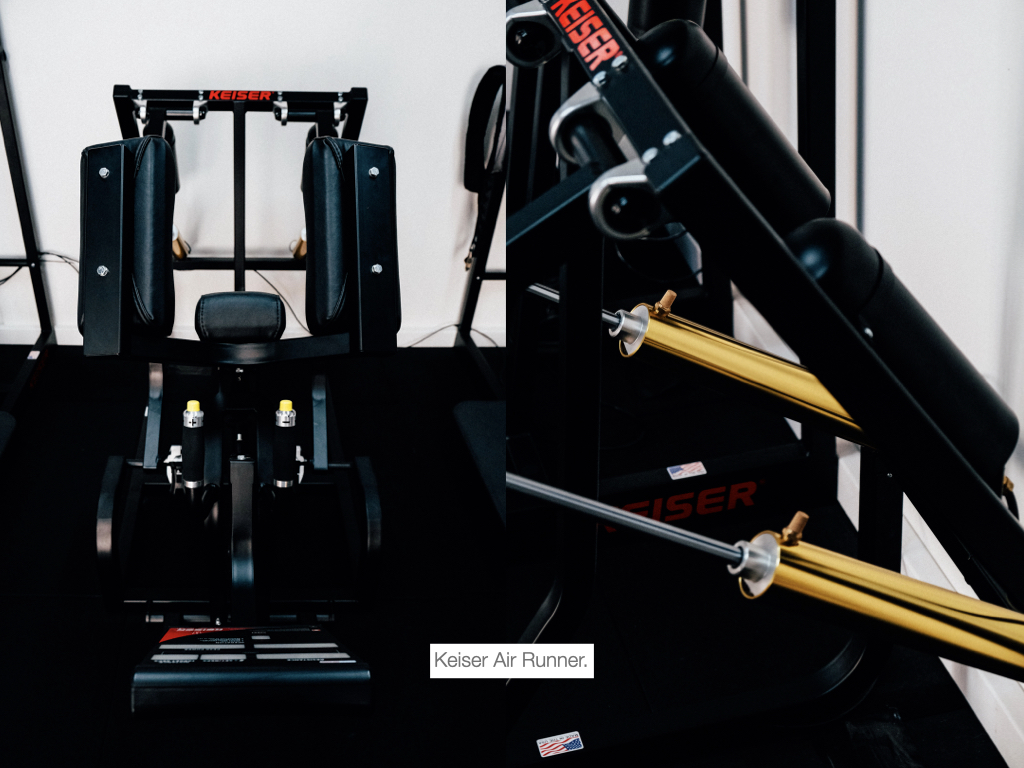
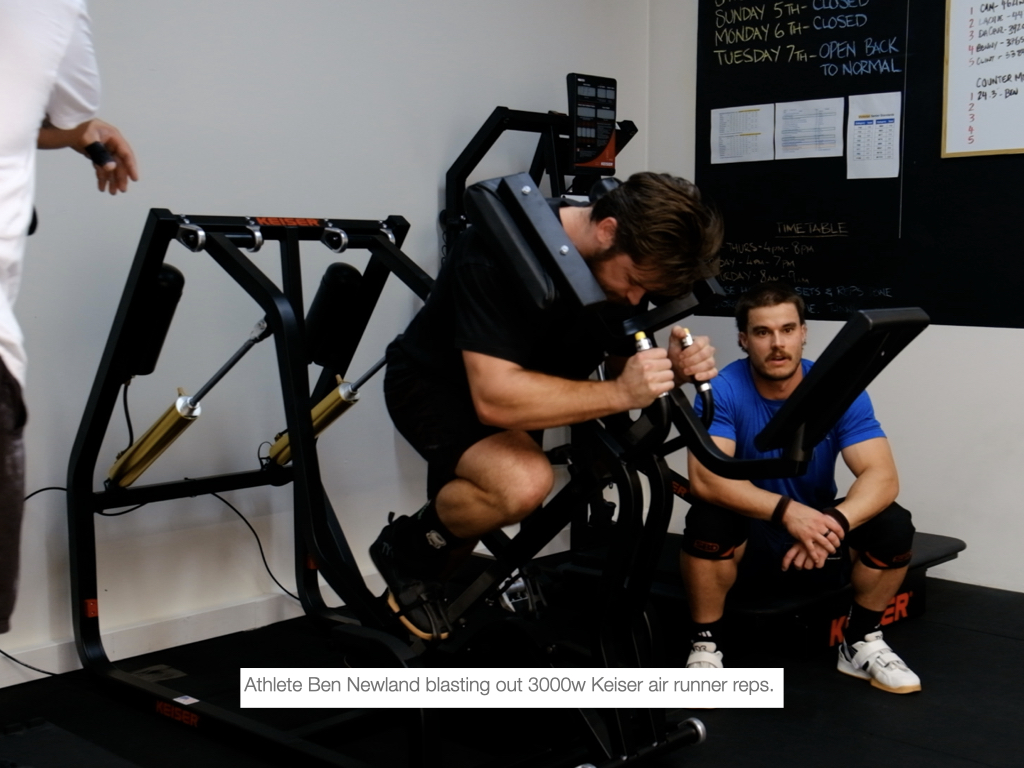
Athletic movements are complex and explosive. To learn them requires exposure to high forces, and due to the fast movement speed, the best way to learn these often requires little to no resistance. Typical training with barbells and mass-based equipment has limitations on speed, making it difficult to teach the athlete how to be explosive. Keiser pneumatic equipment solves this by allowing for high resistance without compromise on movement speed. Specifically for the development of the hip extensors, the Keiser Air Runner provides the opportunity to increase coordination due to high limb velocities while also developing the strength athletes need for their sport.
Typically, this machine is used first at slower speeds to learn the correct joint sequence, similar to the reverse leg press. Once a stable coordination pattern is established, the athlete can focus on developing torque throughout the entire posterior chain, glutes, hamstrings and calves.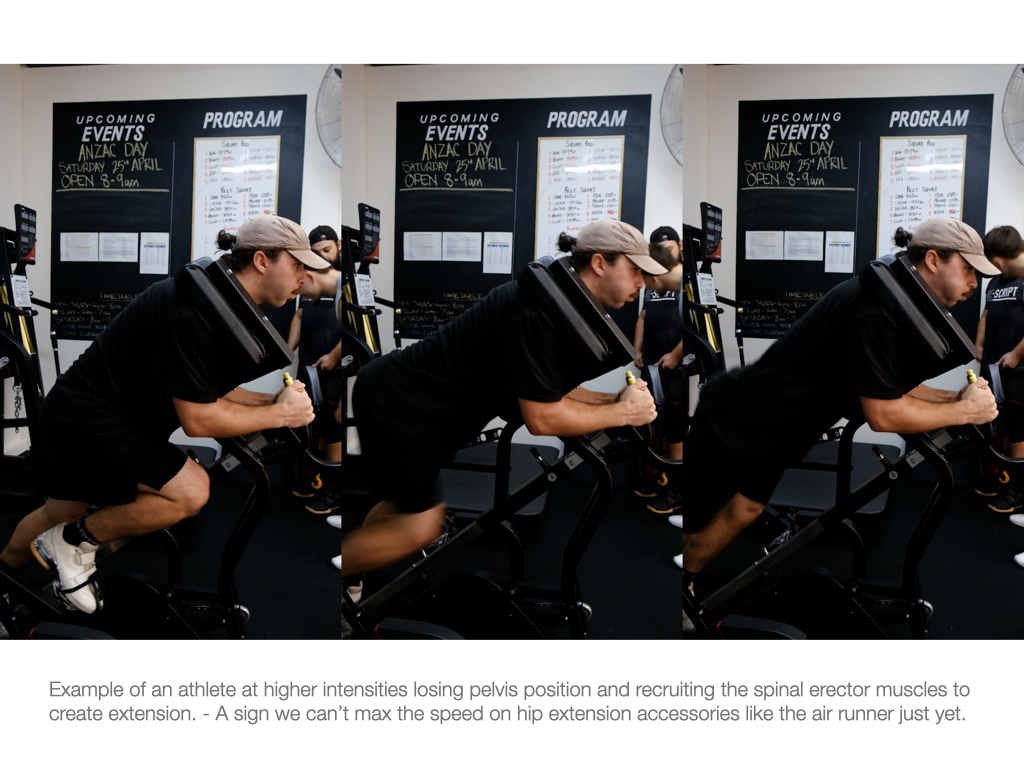
Practical Takeaways
To take your understanding a step further, here is some homework for you to make hip extension a priority in your coaching this week
- Analyse your athletes’ movement: You should always be doing this, but for this week, pay close attention to how they get their hip extension. What strategies do they use? Observe if this changes in different contexts, or is the same for all movements.
- Set up the reverse leg press! There are no excuses for not trying to set this exercise up. Athlete Tiffany makes it work in a CrossFit gym with ring straps!
- Programming: Reflect on your athlete’s programming. How are you addressing your athletes’ hip extension demands?
Thank you for reading this hip extension guide. Remember that just like any other quality, if hip extension is an underdeveloped aspect to your athlete's performance, it will take time to improve and won't happen overnight. Be patient, make it a priority, and the results will come... slowly!
If you’d like to learn more from us, check out our digital library of coaching presentations, exercise libraries, and guest presentations on our Coaches Portal!
References:
Bosch, F. (2015) Strength Training and Coordination: An Integrative Approach. Rotterdam, Netherlands: 20/10 Publishers.
Marieb, E.N., Hoehn, K. and Hutchinson, M. (2014) Human Anatomy & Physiology. Harlow, Essex: Pearson.
